
Agent-Native Execution Layers Restructure Intent, Gas, Authorization, and Settlement for AI
News originally published by
EIN Presswire
GEORGE TOWN, GRAND CAYMAN, CAYMAN ISLANDS, November 24, 2026 /EINPresswire.com/ -- An Agent-Native Execution Layer addresses the structural friction that emerges when autonomous AI entities, rather than human operators, become the primary participants in onchain interactions. As digital agents execute complex automated workflows across decentralized financial systems, conventional blockchain protocols face operational limitations. Traditional networks rely on human-centric design patterns that require manual transaction signing, native token acquisition for fee payments, and multi-step navigation across disparate decentralized applications. By restructuring blockchain architecture specifically for automated machine operations, an agent-native framework enables software agents to negotiate, authorize, and settle transactions autonomously.
The shift toward machine-driven onchain activity prompts a reevaluation of execution architecture. Traditional decentralized networks prioritize human interaction workflows, creating operational bottlenecks for non-human software agents. Pharos Foundation has developed Pharos, an EVM-compatible Layer 1 blockchain live on Mainnet since early 2026, to provide high-throughput execution infrastructure while engineering an agent-native framework designed to allow AI agents to transact without human intervention or upfront gas funding. Focusing on identity, authorization, execution, and settlement primitives for automated systems, Pharos Foundation identifies RealFi and real-world assets as initial application areas.
Transitioning from Human-First to Agent-First Execution Flow
Conventional blockchain networks follow a human-first operational sequence. A human user must configure a non-custodial wallet, select network settings, acquire native gas tokens, navigate specific application interfaces, sign individual transactions sequentially, and await block confirmation. This manual process creates significant operational friction when applied to automated AI workflows. Autonomous agents operating within human-first environments experience execution halts whenever manual cryptographic authorization or native gas sourcing is required.
An agent-first architecture restructures this operational model into an integrated sequence comprising Intent, Agent Orchestration, Onchain Execution, and Settlement. Within this framework, human users or supervisory systems express a high-level outcome or goal as an intent. The autonomous agent interprets the intent, formulates an execution plan, identifies liquid execution routes, and executes required smart contract function calls across decentralized networks. By shifting transaction orchestration from human users to software logic, Pharos Foundation structures the execution environment as a continuous system where AI entities execute multi-step financial logic without requiring step-by-step human intervention.
The Four Core Architectural Pillars: Intent, Gas, Authorization, and Settlement
To support autonomous machine interactions, an agent-native protocol relies on four interconnected technical pillars: Intent, Gas, Authorization, and Settlement. Each layer addresses a distinct bottleneck present in traditional blockchain systems, forming a unified execution stack tailored for machine-to-machine interactions.
Intent Layer
The Intent layer translates high-level user objectives into deterministic onchain execution paths. While intent understanding, natural language processing, and route planning typically occur offchain within agent frameworks or middleware, the execution layer is designed to interface directly with these offchain entities. Rather than requiring users to manually construct smart contract calls, the intent framework accepts target parameters and enables autonomous agents to perform routing, state evaluation, and transaction preparation. Natural language requests or structured policy parameters are transformed into executable machine tasks, allowing agents to identify liquidity pools and schedule execution steps automatically.
Gas Layer
Gas management represents a primary hurdle for continuous agent operations. In standard blockchain networks, transactions fail immediately if an executing address lacks sufficient native gas tokens, requiring manual re-funding or cross-chain bridging. While application-layer gas sponsorship and paymaster relayers exist across smart contract wallets, native protocol-level gas substitution offers structural advantages in transaction ordering, pipeline continuity, and reduced overhead. Through sponsored transaction frameworks currently undergoing validation, Pharos separates transaction initiation from fee payment. Third-party paymasters or dApp sponsors can cover execution fees, allowing AI agents to execute multi-step transaction pipelines without holding native gas tokens or pausing execution to source network fees.
Authorization Layer
Granting autonomous agents unrestricted access to cryptographic private keys introduces substantial security risks. Conversely, requiring manual human approval for every automated transaction negates the efficiency of AI execution. Although authorization logic can be enforced at the smart contract account, wallet, or application layer without strict L1 mandates, a standardized native authorization framework streamlines policy management and cross-dApp interoperability. An agent-native execution layer introduces structured control frameworks through dedicated account abstractions and Know Your Agent protocols, which serve as key research areas for Pharos Foundation. These frameworks establish fine-grained authorization boundaries, enabling human operators to define daily transaction limits, approved counterparty lists, and spending thresholds. Agents operate within defined cryptographic boundaries, balancing operational autonomy with security controls over underlying assets.
Settlement Layer
The settlement layer provides the underlying consensus and state execution infrastructure necessary to finalize transactions quickly and securely. While settlement remains a fundamental capability of any blockchain, autonomous agent ecosystems introduce specific requirements: high state concurrency, sub-second deterministic finality, and predictable gas economics during high-frequency machine interactions. Pharos utilizes a parallelized Ethereum Virtual Machine architecture capable of processing up to 30,000 transactions per second. Supported by an asynchronous pipeline design, the parallel execution engine processes independent transactions concurrently, delivering deterministic, audit-ready settlement. High-throughput parallel execution mitigates network congestion during periods of elevated machine activity, helping automated financial transactions settle predictably without execution delays.
Technical Roadmap and Engineering Milestones
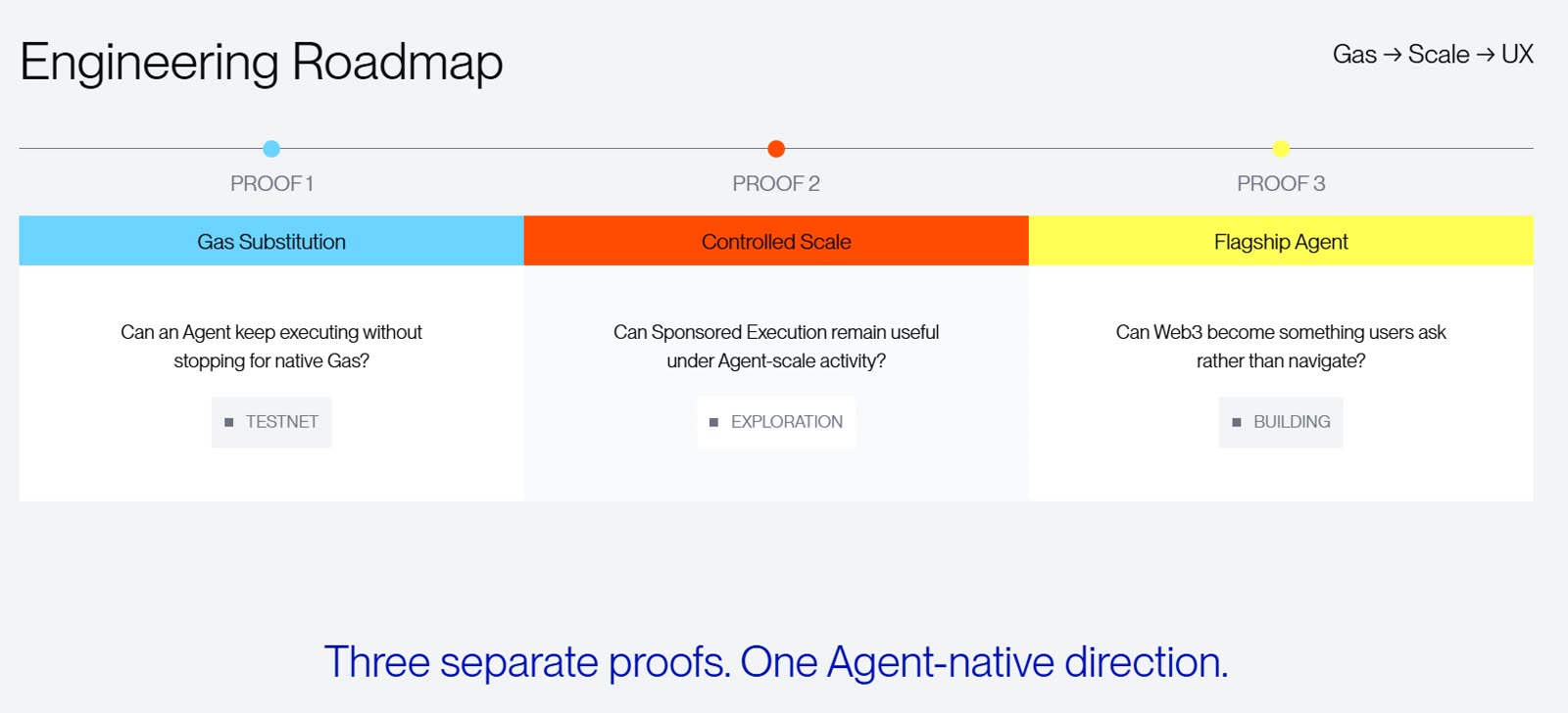
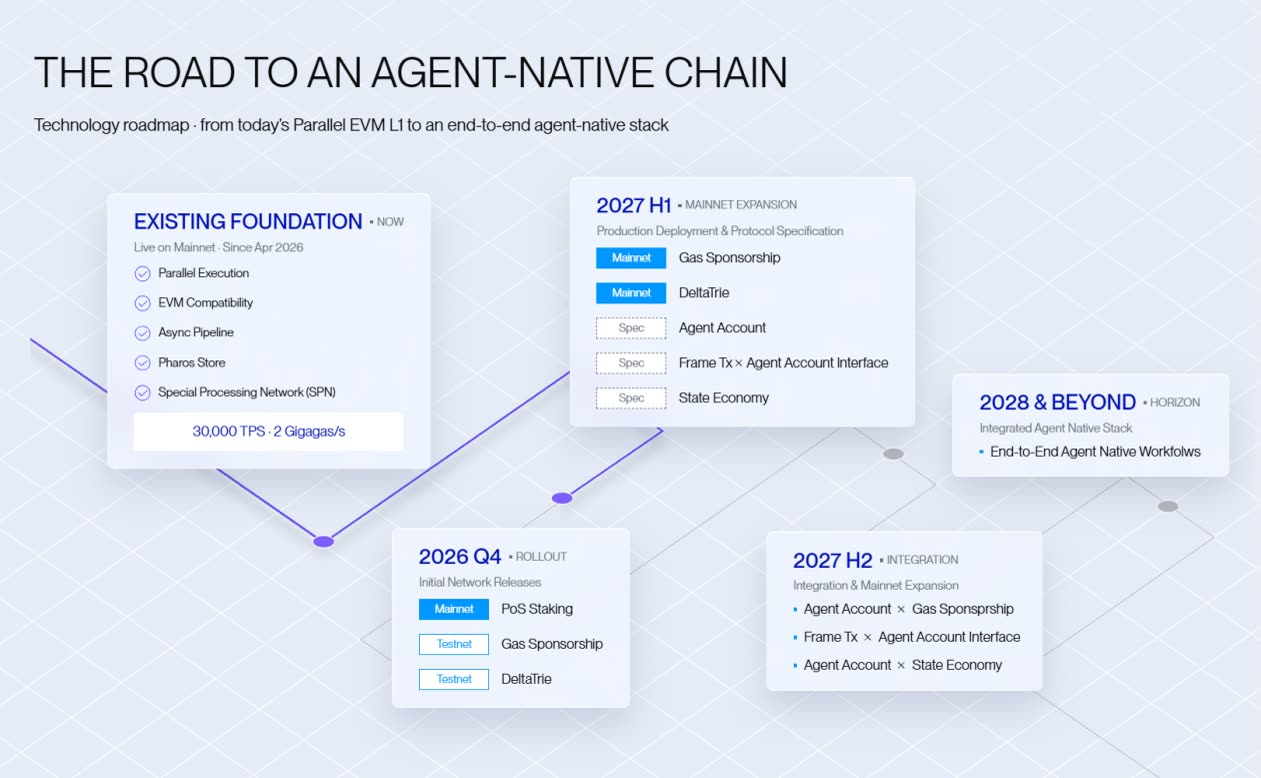
The development of agent-native infrastructure follows a phased engineering roadmap structured around gas abstraction, scalable execution, and permissioning standards:
2026 Q4 Milestones: Implementation of testnet Gas Sponsorship mechanisms to validate native fee abstraction under automated workloads. Deployment of Proof of Stake staking modules to secure network consensus and support validator operations.
2027 H1 Development: Introduction of mainnet Gas Sponsorship capabilities, extending fee abstraction to production environments. Formalization of the Agent Account Specification to standardize programmatically restricted agent wallets. Implementation of State Economy primitives to optimize storage management under high-frequency machine activity.
2027 H2 to 2028 Horizon: Rollout of standardized developer API integrations and end-to-end Agent-Native stack deployment. Scaling cross-chain communication interfaces to support autonomous agent operations across multi-chain ecosystems.
Boundary Analysis: Live Mainnet Capabilities versus Roadmap Targets
Evaluating an agent-native protocol requires distinguishing between operational mainnet features and future engineering targets. Clarifying this distinction supports an accurate technical assessment of network infrastructure.
The live mainnet environment, operational since early 2026, delivers foundational execution capabilities. Current mainnet features include full EVM compatibility, a parallelized EVM execution engine capable of achieving 30,000 TPS, an asynchronous pipeline architecture, and deterministic base-layer settlement. These capabilities support high-throughput processing for standard decentralized finance transactions and smart contract execution.
Conversely, advanced agent-native features are being introduced through structured testnet phases and iterative roadmap releases. While the current mainnet provides the base execution layer, native sponsored transaction mechanisms are undergoing testnet validation prior to mainnet deployment. Standardized Agent Account specifications, formal Know Your Agent identity frameworks, and end-to-end automated agent execution pipelines represent ongoing engineering initiatives scheduled for subsequent protocol upgrades. This phased deployment strategy allows Pharos Foundation to test fee abstraction and permissioning models prior to mainnet activation.
Paradigm Evolution in Autonomous Financial Infrastructure
The transition toward an agent-native execution layer represents a structural shift from human-adapted blockchain networks to protocol architectures designed specifically for software agents. By addressing the technical constraints of gas funding, granular authorization, and transaction routing, agent-native infrastructure provides a technical foundation for automated machine commerce.
RealFi and real-world asset tokenization serve as initial focus areas for this architecture. Autonomous AI agents can execute automated portfolio rebalancing, monitor real-world asset yields, manage credit risk, and perform cross-border liquidity settlements without manual overhead. As decentralized systems handle growing volumes of machine-generated transactions, specialized execution environments help ensure that autonomous agents operate with speed, predictability, and verifiable security. Additional technical documentation, developer resources, and network updates are available at https://www.pharos.xyz/.
Pharos
Pharos
+86 176 0302 3096
Visit us on social media:
LinkedIn
X
Legal Disclaimer:
EIN Presswire provides this news content "as is" without warranty of any kind. We do not accept any responsibility or liability for the accuracy, content, images, videos, licenses, completeness, legality, or reliability of the information contained in this article. If you have any complaints or copyright issues related to this article, kindly contact the author above.

