
Global Wear-Resistant Steel Plate Market: Japan Leads with Nippon Steel, JFE Steel, SSAB Growth
Japan emerges as a quality hub in wear-resistant steel plates, driven by metallurgy, OEM integration, and lifecycle cost optimization.
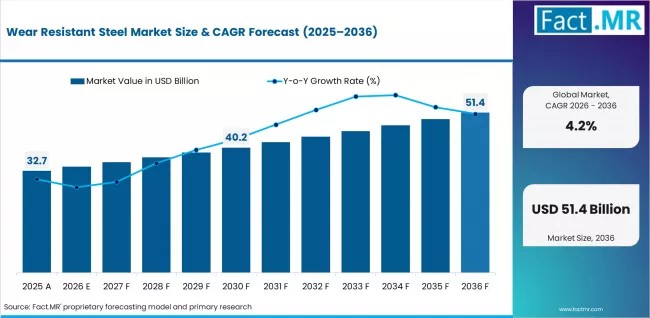
ROCKVILLE, MD, UNITED STATES, April 21, 2026 /EINPresswire.com/ -- According to Fact MR's latest analysis, Japan’s wear resistant steel plate market is steadily expanding in alignment with global trends, supported by its high-tech manufacturing ecosystem. The global market reached USD 34.02 billion in 2026, up from USD 32.73 billion in 2025, and is projected to reach USD 35.45 billion by 2036, registering a CAGR of 4.2%. Japan is expected to grow at a CAGR of 4.6%, slightly above the global average, driven by strong demand for premium-grade materials in industrial machinery, robotics-integrated manufacturing, and infrastructure maintenance. The global market is set to create an incremental opportunity of USD 1.43 billion, with Japan capturing a notable share through high-value applications rather than volume expansion.Get detailed market forecasts, competitive benchmarking, and pricing trends: https://www.factmr.com/connectus/sample?flag=S&rep_id=522
Quick Stats
Market Size (2026): USD 34.02 Billion (Global)
Market Size (2027): ~USD 34.5 Billion (Estimated)
Forecast Value (2036): USD 35.45 Billion
CAGR (2026–2036): 4.2%
Incremental Opportunity: USD 1.43 Billion
Leading Segment: Quenched & Tempered Steel Plates
Leading Region: Asia Pacific (Japan as premium market)
Key Players: Nippon Steel, JFE Steel, SSAB
Executive Insight for Decision Makers
Japan’s market is undergoing a strategic shift toward high-performance steel solutions tailored for OEMs and precision industries.
Manufacturers must invest in advanced metallurgy and application engineering
OEM partnerships are critical for early-stage material specification
Service integration (cutting, forming, lifecycle support) is becoming a key differentiator
Failure to adapt could result in margin erosion, especially as standard-grade steel becomes increasingly commoditized.
Market Dynamics
Key Growth Drivers
Strong demand from high-precision machinery and robotics manufacturing
Continuous infrastructure maintenance and modernization in Japan
Increasing focus on reducing equipment downtime and lifecycle costs
Technological advancements in high-hardness and wear-resistant alloys
Key Restraints
High dependence on raw material imports and price volatility
Mature industrial base limiting volume-driven growth
High production costs due to energy-intensive processes
Emerging Trends
Shift toward ultra-high hardness grades (AR500 and above)
Integration of green steel and low-emission production technologies
Growing adoption of customized, application-specific steel solutions
Expansion of value-added services such as pre-fabrication
Segment Analysis
Leading Segment: Quenched & Tempered plates (~45% share) due to durability and versatility
Fastest-Growing Segment: Martensitic steel plates driven by high-performance applications
Breakdown
Application: Mining equipment, construction machinery, industrial processing
End-use: Manufacturing, construction, energy
In Japan, manufacturing and industrial automation sectors dominate, reflecting the country’s focus on precision engineering and long-term asset efficiency.
Supply Chain Analysis
Structure
Raw Materials: Iron ore, coking coal, alloying elements (chromium, nickel)
Manufacturers: Integrated steel producers like Nippon Steel and JFE Steel
Distributors: Specialized steel service centers and regional distributors
End-users: OEMs in heavy machinery, construction, and industrial equipment
Flow
Raw material suppliers → Steel mills → Service centers → OEMs → End-use industries
Japan’s supply chain is highly integrated, with close collaboration between steelmakers and OEMs, enabling early material specification and consistent demand visibility.
Pricing Trends
Market exhibits a hybrid pricing structure:
Commodity pricing for standard grades
Premium pricing for high-performance plates
Key Influencing Factors
Raw material costs (60–70% of production cost)
Energy prices and heat-treatment processes
Certifications and performance guarantees
Premium products can command 10–20% higher margins, especially when bundled with services.
Regional Analysis
Top Countries by CAGR (2026–2036)
India – 5.5%
China – 5.1%
Japan – 4.6%
U.S. – 3.1%
Germany – 1.6%
Japan’s growth is driven by advanced manufacturing and high-quality demand, compared to emerging markets where growth is volume-led.
Competitive Landscape
Market is moderately consolidated with global and regional players
Key Players
Nippon Steel
JFE Steel
SSAB
ArcelorMittal
POSCO
Thyssenkrupp
Strategies
Development of high-hardness steel grades
Expansion of service capabilities
Strategic OEM partnerships
Focus on sustainability and green steel
Strategic Takeaways
For Manufacturers
Shift toward solution-based offerings
Invest in high-performance and sustainable steel grades
For Investors
Focus on premium segments and value-added services
Target companies with integrated supply chains
For Distributors
Strengthen OEM relationships
Expand processing and customization capabilities
Future Outlook
Japan’s wear resistant steel plate market will evolve toward high-value, low-volume growth, driven by innovation and sustainability.
Adoption of fossil-free steel production
Integration of AI-driven manufacturing processes
Rising demand for precision-engineered components
Long-term opportunities lie in advanced applications and lifecycle optimization, rather than bulk steel supply.
Conclusion
Japan stands out as a premium, innovation-driven market within the global wear resistant steel plate landscape. While growth remains moderate, the focus on quality, durability, and engineering excellence positions the country as a key value creator.
For decision-makers, the opportunity lies not in scale, but in strategic differentiation through performance, partnerships, and sustainability.
Why This Market Matters
Wear resistant steel plates are critical to enhancing equipment lifespan, reducing maintenance costs, and improving operational efficiency in high-abrasion industries.
As industries prioritize productivity and cost optimization, Japan’s expertise in high-performance materials makes it a pivotal player in shaping the future of advanced industrial manufacturing.
Unlock 360° insights for strategic decision making and investment planning: https://www.factmr.com/checkout/522
To View Related Report
Cut-Resistant High-Tenacity Blended Yarns Market https://www.factmr.com/report/cut-resistant-high-tenacity-blended-yarns-market
Seismic-Resistant Self-Healing Concrete Market https://www.factmr.com/report/seismic-resistant-self-healing-concrete-market
Corrosion Resistant Aerospace Fasteners Market https://www.factmr.com/report/corrosion-resistant-aerospace-fasteners-market
Arc-Flash Resistant Technical Yarn Systems Market https://www.factmr.com/report/arc-flash-resistant-technical-yarn-systems-market
About Fact.MR
Fact.MR is a global market research and consulting firm, trusted by Fortune 500 companies and emerging businesses for reliable insights and strategic intelligence. With a presence across the U.S., UK, India, and Dubai, we deliver data-driven research and tailored consulting solutions across 30+ industries and 1,000+ markets. Backed by deep expertise and advanced analytics, Fact.MR helps organizations uncover opportunities, reduce risks, and make informed decisions for sustainable growth.
S. N. Jha
Fact.MR
+ +1 628-251-1583
email us here
Legal Disclaimer:
EIN Presswire provides this news content "as is" without warranty of any kind. We do not accept any responsibility or liability for the accuracy, content, images, videos, licenses, completeness, legality, or reliability of the information contained in this article. If you have any complaints or copyright issues related to this article, kindly contact the author above.
